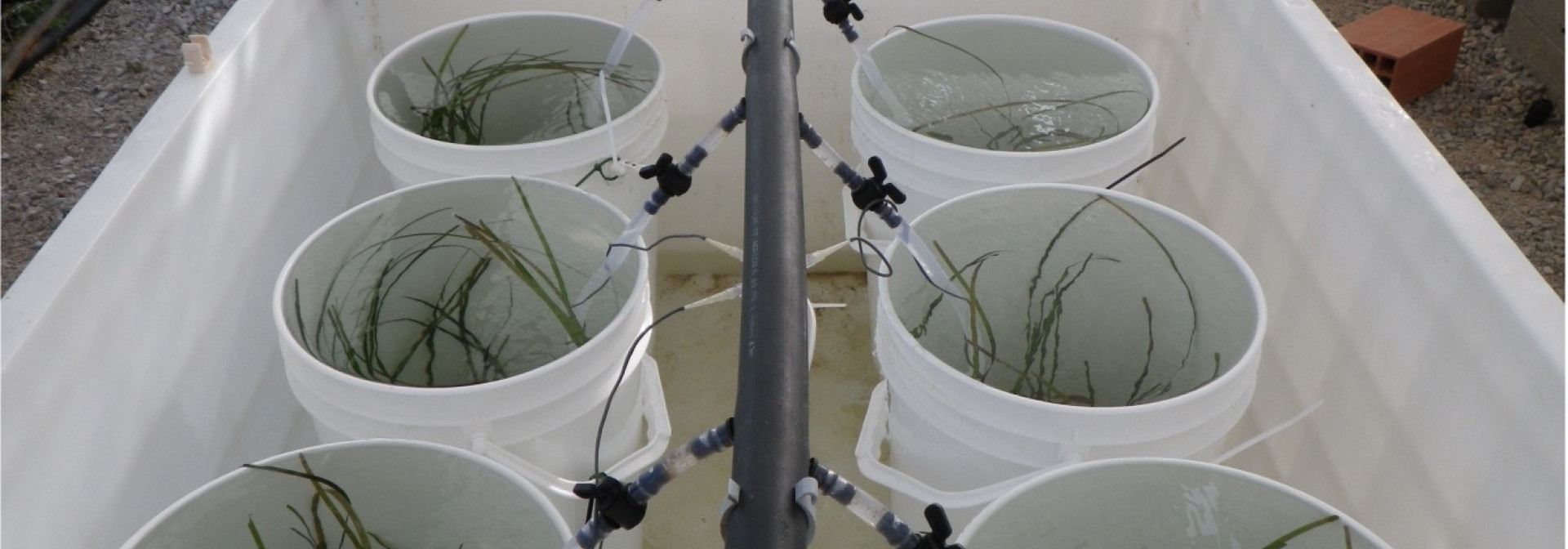
Mesocosm experiment (Ramalhete station)

Project Summary

Anthropogenic CO2 emitted to the atmosphere is absorbed by the oceans, causing a progressive increase in ocean inorganic carbon concentrations, as well as decreased seawater pH and calcium carbonate saturation, resulting in a phenomenon called ocean acidification (OA). The IP led collaborative efforts to determine the relevant but still unknown OA-induced shifts in the interaction between seagrasses and their associated herbivores. This is a key topic for society and managers since herbivory may affect meadow dynamics and overcome the expected benefits of increased carbon availability in the context of future global change. OA interactive effects with nutrient enrichments were investigated in manipulative experiments independently conducted with two seagrass species, C. nodosa and Z. noltei.

Sea urchin (Paracentrotus lividus) in a seagrass meadow

Effects of global elevated CO2 and/or nutrients on seagrass-herbivore interactions

Start and End Date
-
Coordinating Entity
CCMAR
CCMAR Coordinators
Begoña Martínez-Crego
Project reference
Assemble-ccmar01064 (EU Project number 227799), PADI# 6213 (plus individual funding from COST Action ES0906)

Funding agencies

Comissão Europeia
Total Budget
23850.00 €
CCMAR Budget
23850.00€

Project Activities

PI: Begoña Martínez-Crego; International collaborators: Fiona Tomas (Oregon State University, USA; IMEDEA-CSIC, Spain).

Students´ research stays at CCMAR:

Pedro Arteaga (2013), Centre of Marine Sciences (Spain). Role of seagrass traits in driving herbivory impact under elevated CO2 and nutrients. Short Term Scientific Mission, COST Action ES0906. Supervisor: B Martínez-Crego.

Gema Hernán (2012), Mediterranean Institute for Advanced Studies (Spain). Effects of increased CO2 and nutrients on seagrass herbivory. Short Term Scientific Mission, COST Action ES0906. Supervisor: B Martínez-Crego.

Communications in international congresses:

2014. Tomas F, Martínez-Crego B, Hernán G, Santos R. Contrasting effects of eutrophication and acidification on seagrass-herbivore interactions. 37th Annual Meeting Pacific Estuarine Research Society, Newport, Oregon, April 3-5 (oral presentation).

2014. Tomas F, Martínez-Crego B, Hernán G, Santos R. Contrasting effects of ocean acidification, eutrophication and herbivory on seagrass - herbivore interactions. Ocean Sciences Meeting, (ASLO) Honolulu, HI, USA, February 23-28 (oral presentation).

Publications

Martínez-Crego B, Arteaga P, Tomas F, Santos R (2016) The role of seagrass traits in mediating Zostera noltei vulnerability to mesograzers. PLoS One 11(6): e0156848. https://doi.org/10.1371/journal.pone.0156848

Martínez-Crego B^, Tomas F^, Hernán G, Santos R (2015). Responses of seagrass to anthropogenic and natural disturbances do not equally translate to its consumers. Global Change Biology 21, 4021-4030. (^equally contributing first authors). https://doi.org/10.1111/gcb.13024

Martínez-Crego B, Olivé I, Santos R (2014) CO2 and nutrient-driven changes across multiple levels of organization in Zostera noltii ecosystems. Biogeosciences 11, 7237-7249. https://doi.org/10.5194/bg-11-7237-2014

CCMAR Members

Funding

Comissão Europeia