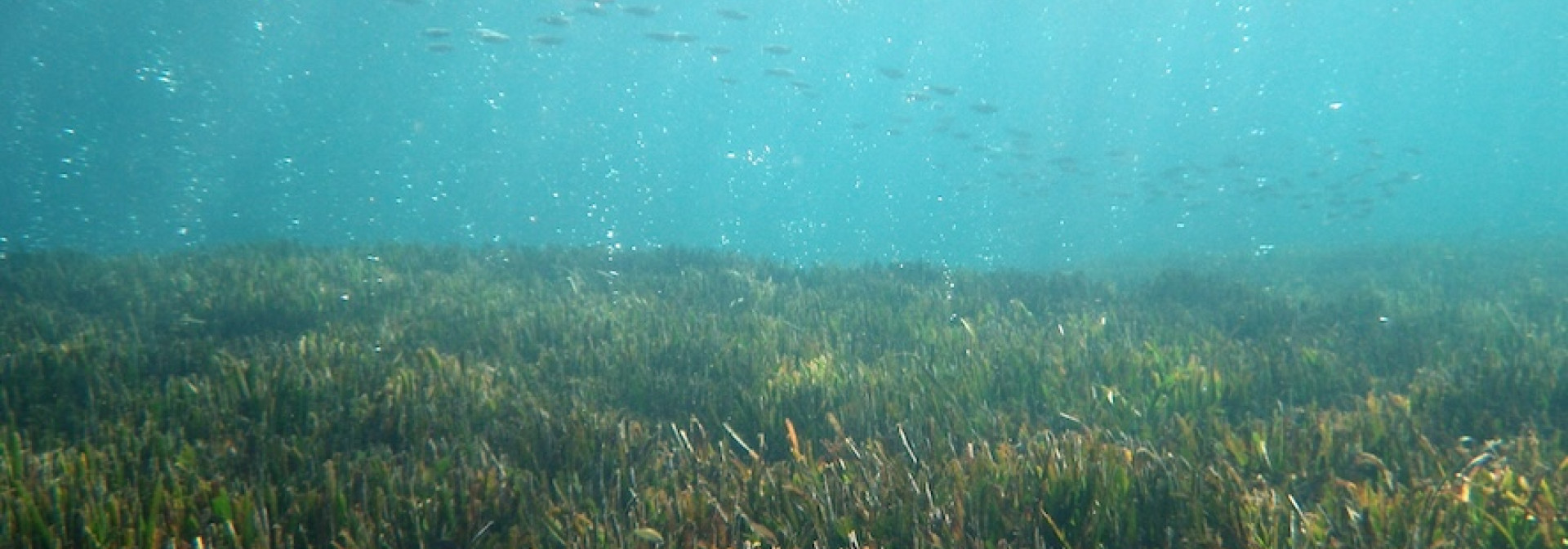
Seagrass (Posidonia oceanica) meadow at the Ischia CO2 vent

Project Summary

Ocean acidification (OA) due to increasing human emissions of CO2 into the atmosphere is causing unequal positive or negative impacts on different species, thus changing the strength of their interactions with largely unpredictable effects on ecosystems. Such impacts have been only scarcely investigated on iconic seagrass ecosystems using CO2-enrichment experiments (see our previous project CONGrass). In this project, we worked in natural CO2 vents to replicate future OA effects, which allows incorporating the full complexity of the interactions’ network, as well as the adaptive potential of species gained across generations. We revealed novel OA-induced changes on trophic species interactions that may contribute to propagate or to stabilize the system, thus, playing a key role on promoting or preventing the loss of seagrass meadows in near-future high CO2 oceans.

Ischia vent

Effects of elevated CO2 from volcanic vents on the trophic structure of seagrass meadows

Start and End Date
-
CCMAR Coordinators
Begoña Martínez-Crego
Project reference
Assemble-SZN#2760/96 (EU Project number 227799) (plus individual funding from COST Action ES0906)

Funding agencies

Comissão Europeia
Total Budget
15000.00 €

Project Activities

PI: Begoña Martínez-Crego; International collaborators: Salvatrice Vizzini (UNIPA, Italy), Cristina Gambi (SZN, Italy).

MSc. thesis by Patricia Nogueira (2015) entitled “Are shifts in sea urchin diet on P. oceanica meadows within CO2 vents, directly linked to effects of ocean acidification?”. International Master of Science in Marine Biodiversity and Conservation (EMBC+), EMBC+ International Consortium of Universities (Universidad del Algarve). Supervisor: B Martínez-Crego. Grade: 16/20

Communications in international congresses:

2016. Nogueira P, Gambi MC, Vizzini S, Califano G, Tavares AM, Santos R, Martínez-Crego B. Altered epiphyte community and sea urchin diet in Posidonia oceanica meadows in the vicinity of a volcanic CO2 vent. MARES Conference: Marine Ecosystems Health and Conservation, Olhâo, Portugal, February 1-5 (poster).

2016. Vizzini S, Martínez-Crego B, Andolina C, Massa-Gallucci A, Mazzola A, Gambi MC. Structural trophic response of benthic macroinvertebrate community to low pH in a naturally acidified shallow ecosystem. 51st European Marine Biology Symposium, Rhodes, Greece, 26-30 September (oral presentation).

2014. Martínez-Crego B, Arteaga P, Santos R. Studying trophic interactions in seagrass ecosystems. International Conference on `Seagrasses in Europe: Threats, Responses and Management’, COST Action ES0906, Olhão, Portugal, March 4-6 (oral presentation).

2014. Andolina C, Martínez-Crego B, Vizzini S, Massa-Gallucci A, Gambi MC. Composition and trophic structure of motile fauna populations in macrophytes of a natural CO2 vent system. 24th Italian Society of Ecology Congress, Ferrara, Italy, September 15-17 (oral presentation).

Publications

Martínez-Crego B, Vizzini S, Califano G, Massa-Gallucci A, Andolina C, Gambi MC, Santos R (2020) Resistance of seagrass habitats to ocean acidification via altered interactions in a tri-trophic chain. Scientific Reports 10, 5103. https://doi.org/10.1038/s41598-020-61753-1

Vizzini S, Martínez-Crego B, Andolina C, Massa-Gallucci A, Connell SD, Gambi MC (2017) Ocean acidification as a driver of community simplification via the collapse of higher-order and rise of lower-order consumers. Scientific Reports 7: 4018. https://www.nature.com/articles/s41598-017-03802-w

Nogueira P, Gambi MC, Vizzini S, Califano G, Tavares AM, Santos R, Martínez-Crego B (2017) Altered epiphyte community and sea urchin diet in Posidonia oceanica meadows in the vicinity of volcanic CO2 vents. Marine Environmental Research 127, 102-111. https://doi.org/10.1016/j.marenvres.2017.04.002

Funding

Comissão Europeia