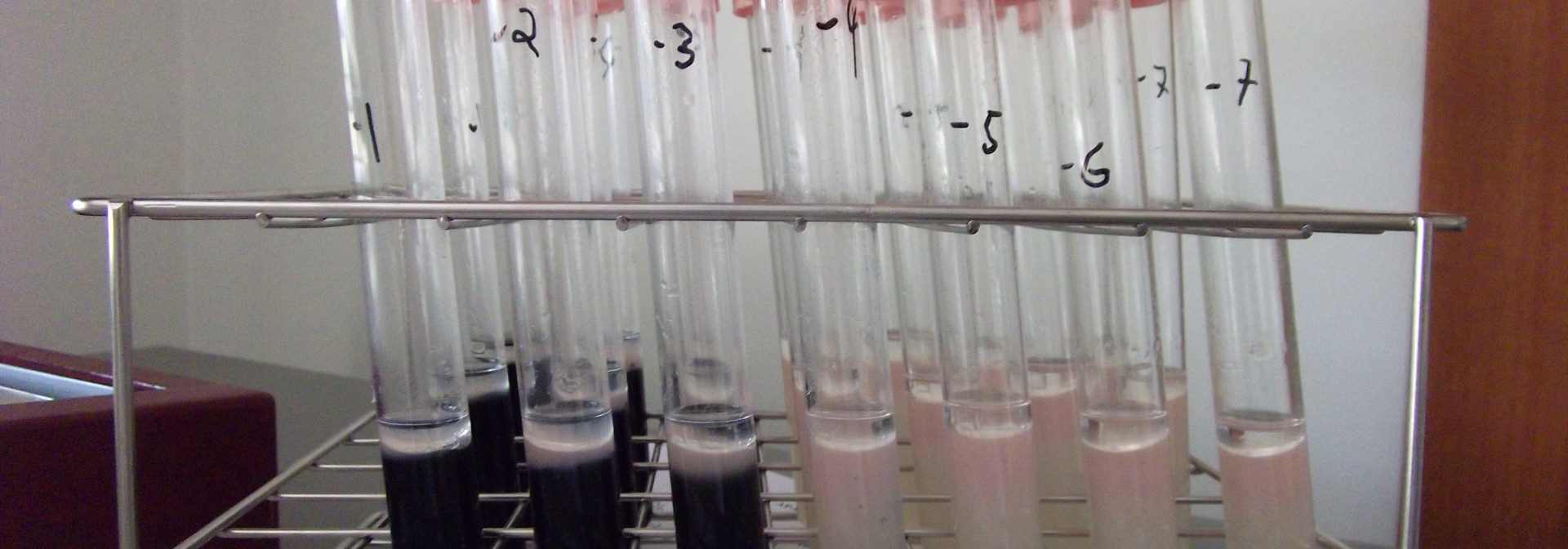
Contagem de SRB

BIONANOMINE

Project Summary

This project intended to study the production of nanosized materials as a result of a sulphate-reducing bioremediation process for the treatment of acid mine drainage (AMD), by precipitating heavy metal ions into the corresponding metal sulphides. The main goal was the synthesis of metal sulphide semiconductor nanoparticles using the most promising bioremediation systems previously developed, based on the use of upflow anaerobic packed-bed bioreactors (UAPB). The nanomaterials were morphologically and structurally characterized using X-ray diffraction, transmission and scanning electron microscopy and elemental analysis. Optical and electronic properties were also evaluated. Considering that a wide range of nanomaterials can be produced, this project aimed to define the best conditions to produce nanomaterials with suitable properties. In this project, the AMD, a waste, was treated and at the same time useful products were obtained instead of sub products that need to be disposed of, which can bring environmental and economical beneficial.

Lab scale bioreactorswith sulphate-reducing bacteria

Bio-synthesis of nanosized semiconductors using mine wastes as material sources and environmentally friendly applications

Start and End Date
-
Coordinating Entity
CCMAR
CCMAR Coordinators
Project reference
PTDC/AAG-TEC/2721/2012

Funding agencies

FCT - Fundação para a Ciência e Tecnologia
Total Budget
154443.00 €
CCMAR Budget
80210.00€

Project Activities

Objectives of BIONANOMINE project:

  1. Synthesis of metal sulphide nanoparticles (NPs) by the bioremediation process
  2. Synthesis of metal sulphide nanocomposites by the bioremediation process
  3. Morphological, structural and electrical characterization of the nanoparticles and nanocomposites
  4. Evaluate the photochemical properties of the NPs and nanocomposites aiming their utilization as photocatalysts for the degradation of organic pollutants in water
  5. Access the potential application of the synthesised nanoparticles in polymer composite low cost solar cells

Achievements:

Obtained nanomaterials were morphologically and structurally characterized using mainly X-ray diffraction and transmission and/or scanning electron microscopy. Their semi-conductor properties were also evaluated.

In fact, due to their unique properties, semiconductor nanomaterials are the basis of innovative technologies. Thus, in this research, these nanomaterials, as well as their derived composites, were investigated as photocatalysts in distinct degradation processes of organic environmental pollutants. In addition, the application of the synthesized nanoparticles in polymer composite low cost solar cells was evaluated, taking into account the increasing need of energetic alternatives.

It should be emphasized that, with this project, the AMD, a waste, is treated and at the same time several useful products were obtained (e.g. several metal sulphide NPs and nanocomposites and even Au(0)) instead of wastes (H2S). Thus, besides the benefits arising from AMD decontamination by using this technology, the production of valuable materials that can bring beneficial environmental and economical was possible.

Publications

Articles in scientific journals:

J. P. Costa, A. V Girão, J. P. Lourenço, O. C. Monteiro, T. Trindade, M. C. Costa, (2013) Green synthesis of covellite nanocrystals using biologically generated sulfide: Potential for bioremediation systems. Journal of Environmental Management, 128: 226-232. https://doi.org/10.1016/j.jenvman.2013.05.034

J. P. Costa, A. V. Girão, O. C. Monteiro, T. Trindade, M. C. Costa, (2015) Biotechnologically obtained nanocomposites: A practical application for photodegradation of Safranin-T under UV-Vis and solar light. Journal of Environmental Science and Health, Part A, 50: 1–13. https://doi.org/10.1080/10934529.2015.1038155

G. Vitor, T.C. Palma, B. Vieira, J.P. Lourenço, R.J. Barros, M.C. Costa. (2015) Start-up, adjustment and long-term performance of a two-stage bioremediation process, treating real acid mine drainage, coupled with biosynthesis of ZnS nanoparticles and ZnS/TiO2 nanocomposites. Minerals Engineering, 75: 85–93. https://doi.org/10.1016/j.mineng.2014.12.003

A. Assunção, A. Matos, A.M.R. da Costa, A. Candeias, M.C. Costa (2016) A bridge between liquid-liquid extraction and the use of bacterial communities for palladium and platinum recovery as nanosized metal sulphides. Hydrometallurgy, 163: 40-48. https://doi.org/10.1016/j.hydromet.2016.03.012

A. Assunção, M.C. Costa, J.D. Carlier (2016) Application of urea–agarose gel electrophoresis to select non-redundant 16S rRNAs for taxonomic studies: palladium(II) removal bacteria. Applied Microbiology and Biotechnology. 100(6): 2721-2735. https://doi.org/10.1007/s00253-015-7163-3

Oral communictions:

G. Vitor, B. Vieira, J.P. Lourenço, O.C. Monteiro and M.C. Costa, Feasibility of PbS NPs Synthesised coupled to a bioremediation system for acid mine drainage treatment, Proceedings of CEST 2015, Rhodes, Greece, September 2015.

B. Vieira, G. Vitor, O.C. Monteiro, M.C. Costa, "Bio-synthesis of semiconductor nanomaterials and their application on pollutants photocatalytic degradation", Invited keynote, Istanbul, Turkey, Jul. 2015.

T.L. Palma, O.C. Monteiro, J. Pinto da Costa, J.P. Lourenço, M.C. Costa, “Production of PbS (galena) nanoparticles and nanocomposites using biologically generated sulphide”, Proceedings of the 2nd International Conference: WASTES:Solutions, Treatments and Opportunities, CVR - Centro para a Valorização de Resíduos, F. Castro, C. Vilarinho, J. Carvalho, A. Castro, J. Araújo, A. Pedro, (Eds), Braga, Portugal, 11-13 Setembro 2013.

J. Pinto da Costa, A. Girão, J. Lourenço, O.C. Monteiro, T. Trindade, M.C. Costa, “Integrated synthesis of nanosized semicnductors in a bioremediation system for the treament of AMD using biollogically produced sulfide”, Proceedings of the International Mine Water Association Annual Conference 2013, IMWA 2013, Golden, Colorado, USA, August 2013.

CCMAR Coordinators

Funding

FCT - Fundação para a Ciência e Tecnologia