RESTORESEAS

RESTORESEAS

Project Summary

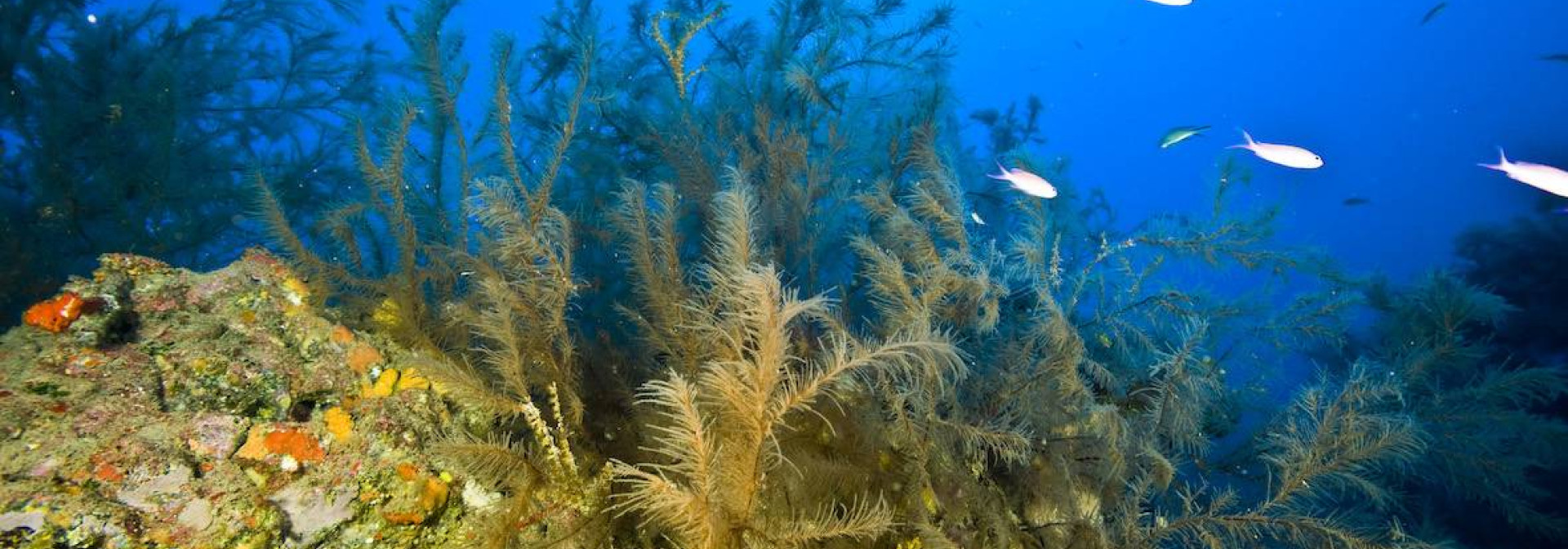
Marine forests are biodiversity-rich ecosystems engineered by key structural taxa of macroalgae, seagrasses and corals. They provide many ecosystem services for humanity, however, they are disappearing at unprecedented rates.

The loss of these marine forests is a catastrophic event, causing loss of ecosystem services that are essential for humanity, including 1) nursery and feeding grounds for many marine species, 2) coastal protection against erosion, 3) counteracting climate change by carbon sequestration.

Yet, out of sight and challenging to reach, below the ocean surface, marine forest restoration is rare, despite massive scales of degradation. RESTORESEAS aims to improve resilience of restoration of marine habitats in the Atlantic coasts, by applying novel nature-based solutions.

With RESTORESEAS we will bring novelty on how to protect and restore marine forests. We will test, for instance, critical restoration efforts needed to reverse tipping points; we will work on a global scale with real data from many partners and use modelling approaches to create unprecedented predictions of restoration and conservation needs for adaptive traits to be considered in policy planning. We will widely integrate citizens and stakeholders in marine restoration to add educational value and ensure upscaling in space and long-term results.

RESTORESEAS

Marine Forests of animals, plants and algae: nature-based tools to protect and restore biodiversity

Start and End Date
-
Coordinating Entity
CCMAR
Project reference
DivRestore/0013/2020

Funding agencies

FCT - Fundação para a Ciência e Tecnologia
Governo - República Portuguesa
CCMAR Budget
145500.00€

Publications

  • 2023
    • Mourato, C.V., Padrão, N., Serrão, E.A. and Paulo, D., 2023. Less Is More: Seagrass Restoration Success Using Less Vegetation per Area. Sustainability, 15(17), p.12937. https://doi.org/10.3390/su151712937
    • Assis J, Alberto F, Macaya E, Castilho N, Faugeron S, Pearson G, Ladah L, Reed D, Raimondi P, Mansilla A, Brickle P, Zuccarello G, Serrao EA (2023) Past climate-driven range shifts structuring intraspecific biodiversity levels of the giant kelp (Macrocystis pyrifera) at global scales.  Scientific Reports 13, 12046 (2023). https://doi.org/10.1038/s41598-023-38944-7
    • Fragkopoulou, E., Sen Gupta, A., Costello, M.J., Wernberg T, Araujo MB, Serrao EA, De Clerck O, Assis J (2023) Marine biodiversity exposed to prolonged and intense subsurface heatwaves. Nat. Clim. Chang. (2023). https://doi.org/10.1038/s41558-023-01790-6
    • Miranda, L. S., Tavares, S., Santos, A. dos, Gonçalves, E. J., Serrão, E. A., & Coelho, M. A. G. (2023). Lipkea ruspoliana Vogt, 1886 (Cnidaria: Staurozoa) in Portugal: the contribution of citizen science to range extension and taxonomic discussion of rare species. Aquatic Ecology, 1–15. https://doi.org/10.1007/s10452-023-10070-6
    • Balogh, V., Fragkopoulou, E., Serrão, E. A., & Assis, J. (2023). A dataset of cold-water coral distribution records. Data in Brief, 48, 109223. https://doi.org/10.1016/j.dib.2023.109223
    • Tavares, A.I., Assis, J., Larkin, P.D., Creed, J.C., Magalhães, K., Horta, P., Engelen, A., Cardoso, N., Barbosa, C., Pontes, S. and Regalla, A., 2023. Long range gene flow beyond predictions from oceanographic transport in a tropical marine foundation species. Scientific Reports, 13(1), p.9112. https://doi.org/10.1038/s41598-023-36367-y
    • Liboreau P, Pearson GA, Barreto L, Serrao EA, Kreiner A, Martins N (2023) Effects of thermal history on reproductive success and cross-generational effects in the kelp Laminaria pallida (Phaeophyceae). Mar Ecol Prog Ser, v. 715, 41-56. https://doi.org/10.3354/meps14357
    • Coelho, M.A., Pearson, G.A., Boavida, J.R., Paulo, D., Aurelle, D., Arnaud‐Haond, S., Gómez‐Gras, D., Bensoussan, N., López‐Sendino, P., Cerrano, C. and Kipson, S., 2023. Not out of the Mediterranean: Atlantic populations of the gorgonian Paramuricea clavata are a separate sister species under further lineage diversification. Ecology and Evolution, 13(1), e9740. https://doi.org/10.1002/ece3.9740


  • 2022
    • Coelho, M.A., Ledoux, J.B., Boavida, J., Paulo, D., Gómez-Gras, D., Bensoussan, N., López-Sendino, P., Cerrano, C., Kipson, S., Bakran-Petricioli, T. and Garrabou, J., 2022. Complete mitochondrial genome of the branching octocoral Paramuricea grayi (Johnson, 1861), phylogenetic relationships and divergence analysis. Mitochondrial DNA Part B, 7(11), pp.1985-1988. https://doi.org/10.1080/23802359.2022.2143246
    • Tavares, A.I., Assis, J., Patrício, R., Ferreira, R., Cheikh, M.A., Bandeira, S., Regalla, A., Santos, I., Potouroglou, M., Nicolau, S. and Teodosio, M.A., 2022. Seagrass connectivity on the west coast of Africa supports the hypothesis of grazer-mediated seed dispersal. Frontiers in Marine Science, p.852. https://doi.org/10.1038/s41598-023-36367-y
    • Almeida, S.C., Neiva, J., Sousa, F., Martins, N., Cox, C.J., Melo‐Ferreira, J., Guiry, M.D., Serrão, E.A. and Pearson, G.A., 2022. A low‐latitude species pump: Peripheral isolation, parapatric speciation and mating‐system evolution converge in a marine radiation. Molecular Ecology, 31(18), pp.4797-4817. https://doi.org/10.1111/mec.16623
    • Fragkopoulou, E., Serrão, E.A., De Clerck, O., Costello, M.J., Araújo, M.B., Duarte, C.M., Krause‐Jensen, D. and Assis, J., 2022. Global biodiversity patterns of marine forests of brown macroalgae. Global Ecology and Biogeography, 31(4), pp.636-648. https://doi.org/10.1111/geb.13450
    • Gouvêa, L.P., Serrão, E.A., Cavanaugh, K., Gurgel, C.F., Horta, P.A. and Assis, J., 2022. Global impacts of projected climate changes on the extent and aboveground biomass of mangrove forests. Diversity and Distributions, 28(11), pp.2349-2360. https://doi.org/10.1111/ddi.13631

Other publications and works by the RESTORESEAS consortium

Funding agencies

FCT - Fundação para a Ciência e Tecnologia
Governo - República Portuguesa