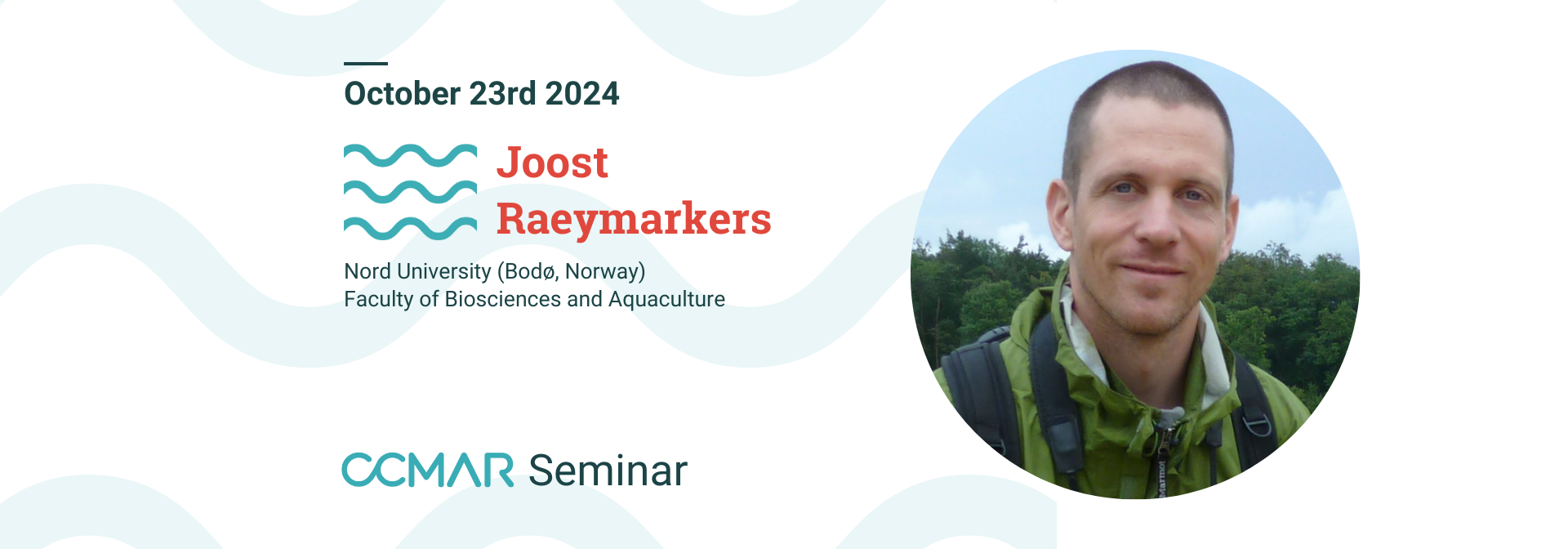
CCMAR Seminars by Joost Raeymaekers
23rd OCT | 13:30 | Room 1.39 - Building 7
Climate change and harvesting impacts on Lake Tanganyika's pelagic fishes
Joost Raeymaekers
Abstract
The pelagic ecosystem in Lake Tanganyika is of tremendous importance for biological diversity and the local communities around the lake. The nearly 100,000 fishermen catch up to 200,000 tonnes of fish each year. In comparison, only cod and herring have larger catches in the Norwegian fisheries. Most of the catch includes two small fish species, Stolothrissa tanganicae and Limnothrissa miodon, often called "freshwater sardines", along with a larger fish, Lates stappersii. The fishery is nutritionally and economically important for over 10 million people who live around the lake. However, the fish are at risk of decline due to climate change and overfishing. While overexploitation may lead to direct declines, the warming climate may cause stronger stratification of the water layers. This can lead to less plant and animal plankton growth, and thus less food for the fish. During the seminar, I will give an overview of work on the pelagic fish stocks of Lake Tanganyika, which aims at exploring the effects of climate change and harvesting at the ecological and evolutionary level, such as changes in genetic structure, trophic position and growth.
Bio
Joost Raeymaekers is a Professor at the Landscape Genomics Group, Faculty of Biosciences and Aquaculture in Nord University (Bodø, Norway), one of the SEA-EU universities. His main research areas include population genetics and evolutionary ecology, mostly focusing on aquatic organisms. During my stay at CCMAR (FBC) I hope to learn more about fisheries biology in support of our work on the pelagic fishes of Lake Tanganyika.
This seminar will be hosted by Professor Karim Erzini
Eventos relacionados