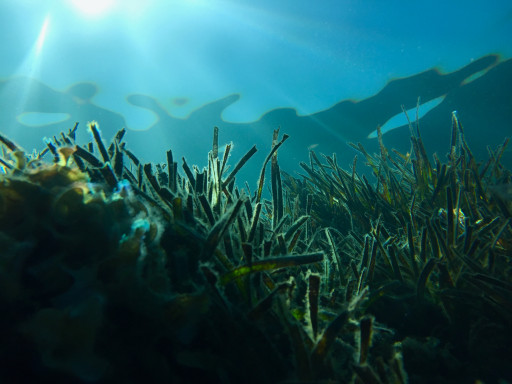
A groundbreaking study carried out by an international team of researchers from Centro de Investigação Marinha e Ambiental, Laboratório Associado (CIMAR-LA), has revealed that seaweed forests transport around 56 million tons of carbon that sink in the deep ocean, contributing significantly to regulating the amount of CO2 in the atmosphere and, consequently, the Earth's climate.
This discovery, now published in the prestigious journal Nature Geoscience, opens up new opportunities for mitigating climate change through the preservation and restoration of marine kelp forests.
Kelp forests, composed mainly of giant brown algae like the famous kelp, are the most extensive and productive vegetated coastal ecosystems on the planet. These forests can grow as quickly as terrestrial forests, which makes them highly efficient at capturing and storing carbon.
The international study “Carbon export from seaweed forests to deep ocean sinks”, led by Dr. Karen Filbee-Dexter from the Norwegian Institute of Marine Research and the University of Western Australia, reveals that, every year, seaweed forests export around 15% of their carbon to the deep ocean, where it can remain trapped for hundreds or thousands of years. These estimates were made on the basis of state-of-the-art global ocean models, which made it possible to trace the fate of seaweed carbon from the coast to the deep ocean.
Marine forests and blue carbon
Historically, seaweed forests have been excluded from "blue carbon" due to uncertainties about their ability to effectively remove carbon in the long term. This study closes this knowledge gap and opens up new opportunities for climate change mitigation in polar and temperate zones, where carbon removal options by coastal ecosystems are currently limited.
Jorge Assis and Isabel Sousa Pinto, researchers at CIMAR - LA and co-authors of this internationally renowned study, indicate that these results are of great importance for marine conservation, since the loss or degradation of these marine forest populations leads to the interruption of the absorption and transport of atmospheric carbon to the deep sea, where it is potentially retained for centuries or even millennia.
Protect, manage and restore
The study underlines the urgent need to protect, manage and restore marine kelp forests, which are currently being lost in many regions of the world due to a variety of pressures, including climate change, typically translated into extreme heat waves, but also pollution and fishing.
Isabel Sousa Pinto, a researcher at the Centro Interdisciplinar de Investigação Marinha e Ambiental da Universidade do Porto (CIIMAR-UP) and CIMAR-LA, stresses the importance of conserving and restoring kelp forests, "not only because of their role in removing carbon, but especially because of their role as a nursery and refuge for many species of animals, many of them important for fishing". Jorge Assis researcher at Centro de Ciências do Mar do Algarve (CCMAR) and CIMAR-LA, adds that "marine forests are a resource for combating climate change and preserving biodiversity in our oceans, and should be a priority for our country".