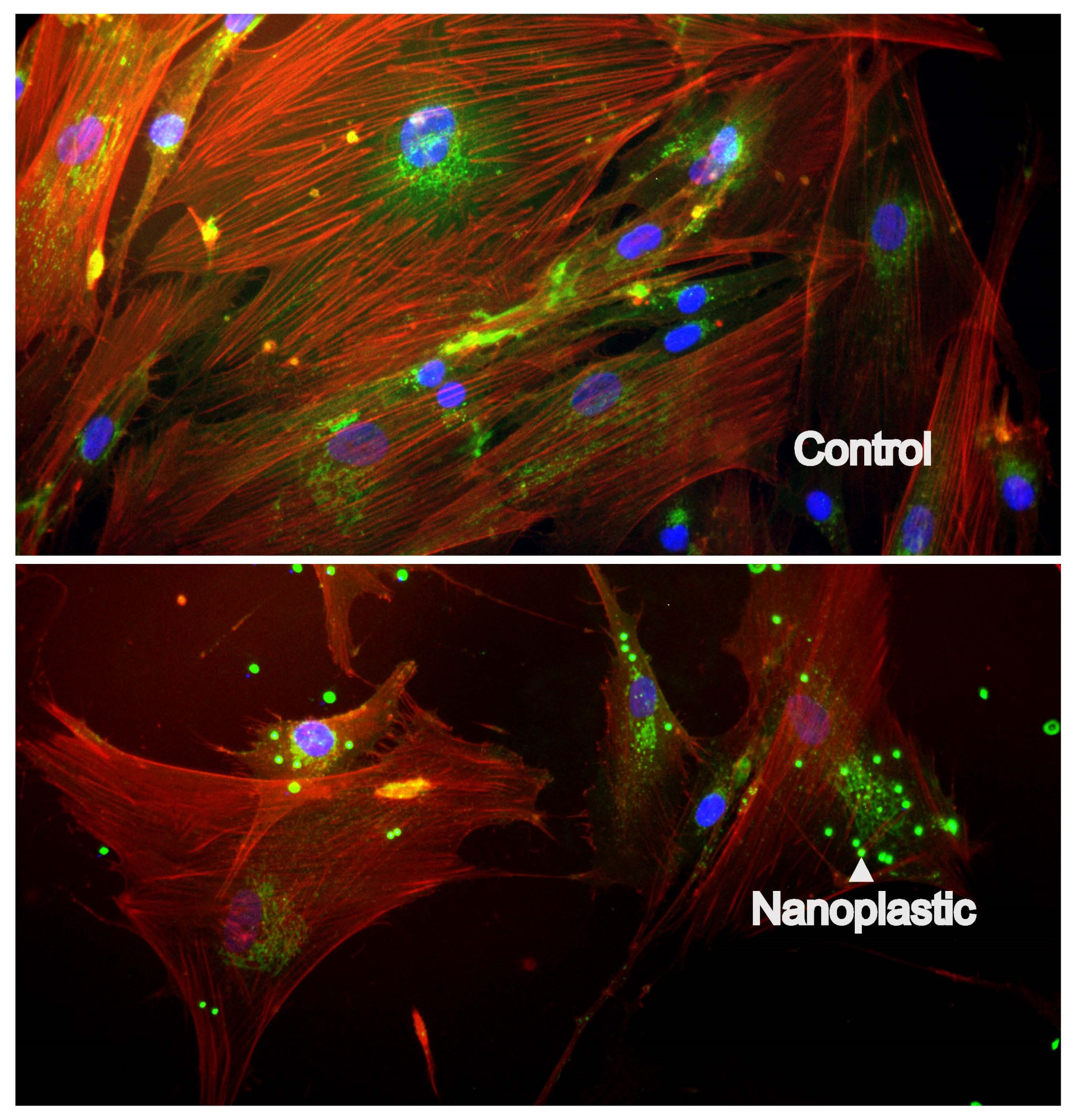
Led by researchers from the Algarve Marine Science Centre (CCMAR) and the University of Algarve (UAlg), this study reveals that exposure to nanoplastics triggers adverse responses in the skin cells of fish and humans, emphasising the need to implement measures to control the levels of plastics in the environment.
Global plastic production has grown dramatically in recent decades, exacerbating plastic pollution around the world. The harmful effects of plastic on the environment are already well known, but we still know little about its effects on organisms and human health. One of the biggest problems with this type of pollution is the fact that plastics break down into smaller and smaller particles over their lifetime. Plastic nanoparticles, which are not visible to the naked eye because they are thousands of times smaller than a millimetre, are now found in every ecosystem in the world. Because of their tiny size, these nanoplastics are absorbed by living organisms in the food and water they eat, through the air they breathe and even through contact with their skin.
Due to the growing presence of nanoplastics in the environment, and the continuous contact that marine and terrestrial animals have with them, it is urgent to understand how nanoplastics interact with the skin, which is one of the first points of contact with plastics. In the context of the PLASTIFISH project (FCT), an international project with Macao, China, a team of researchers from CCMAR - Centro de Ciências do Mar do Algarve and the Universidade do Algarve led a pioneering study into the effects of nanoplastic absorption by skin cells of zebrafish and humans, published in the journal Science of The Total Environment.
In this study, the researchers developed an innovative in vitro approach to study the effects of nanoplastic absorption on the main cells that make up the dermis, called fibroblasts. Maoxiao Peng, a researcher at CCMAR and UAlg, explains that "this new approach allows the use of skin cell lines in a laboratory environment to gather consistent and robust information on the effects of nanoplastics, which makes it more ethical and faster because it avoids the use of animals for the same purpose".
With this new approach, the research team revealed that nanoplastics trigger different physiological responses in the various types of fibroblast cells that were studied, accumulating consistently around the nucleus and membranes of the cells. According to CCMAR and UAlg researcher Rute Félix, "we were able to verify that the negative effects on skin cells vary according to the characteristics of the nanoplastics, such as their size and concentration. These results suggest that nanoplastics can compromise skin health."
Deborah Power, researcher at CCMAR and Professor at UAlg, emphasises that "this study paves the way for a better assessment of the risks and effects of nanoplastics at a biological and ecosystem level, and highlights the urgent need to implement measures to reduce the presence of plastics in the environment around us, given their potential to affect human health and the biosystem in general".
This study represents an important step forward in understanding the impact of nanoplastics on skin health. It can be consulted online here: https://www.sciencedirect.com/science/article/pii/S004896972400113X?via%3Dihub