

Carolina Schilling, Catarina Marreiros and João Monteiro, CCMAR PhD students, took on the challenge of presenting their thesis to the community in 3 minutes. The three students made it to the finals and took part in the public presentation on Saturday 11 May.
This competition, designed to promote science communication and empower PhD students and scientists, has had a significant impact on the careers of our researchers. They all emphasise the importance of these presentations to the community, both in terms of disseminating their knowledge and improving their communication skills. Finally, they emphasise the importance of science communication and advise their colleagues to take part in future editions.
See below the incredible presentations of the three researchers and their impressions of the experience.
Carolina Schilling: “Even sharks were once young uncovering hammerhead shark nursery areas in Mauritania, West Africa”
Carolina explains how the hammerhead shark, a critically endangered species that does not receive parental care, seeks out shallow, protected waters as a juvenile, places that biologists call nurseries.
Sharks play an important role in maintaining the balance of populations in the ecosystem, so Carolina worked directly with fishermen in Mauritania to find these nurseries sites. With this information, the researcher will be able to make management recommendations for these areas, ensuring the growth and reproduction of juveniles and the future of the species.
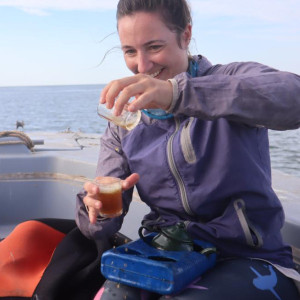
"Summarising our work in such a short time is usually a difficult task for us scientists, especially without using the technical vocabulary we're used to because we feel it leads to a lack of accuracy or an oversimplification of the underlying science. To do this, I had to learn not only how to simplify and filter out all the unnecessary detail, but also how to make it interesting and relatable to someone who knows nothing about marine biology".
Catarina Marreiros: “Predicting the risk of cardiovascular disease. Gla-rich protein (GRP): a missing piece of the puzzle”
Catarina talks about the burden of cardiovascular diseases on society and how they are often diagnosed too late. It's difficult for doctors to make an accurate diagnosis without knowing what's going on inside our blood cells - which Catarina translates this as trying to solve a puzzle without having all the pieces.
In her PhD, Catarina discovered the last missing piece: the detection of a gla-rich protein (GRP). Her tests have shown that low levels of this protein are associated with damage to blood cells. The researcher now wants to show doctors the benefits of the GRP protein, so that they can recommend blood tests to assess its levels and use the test as a tool to identify people at risk of cardiovascular problems.

"I saw this competition as a unique opportunity to present my work to a wider and more diverse audience within the academic community at the University of the Algarve. I learnt a number of valuable lessons. The first was the importance of communicating the results of my research in a clear and concise manner. Adapting technical language to make it accessible to a non-specialist audience. In addition, the feedback from the evaluators and the presentations of the other finalists provided me with a unique opportunity to learn from my peers and refine my communication skills."
João Monteiro: “The extinction of crab fishing”
João Monteiro explains his study of crab fishing from the perspective of Mr António, a retired fisherman on a low pension. Because of the laws in Portugal, Mr António is forced to discard more than half of his catch every day, which greatly reduces his income and the interest of others in this type of fishing.
One of the conclusions João draws in his thesis is that the minimum size for crab fishing could be reduced by almost half without affecting the future of the species, which would allow Mr António to stop discarding so many crabs and double his income. This underlines the need to update crab fishing legislation in Portugal.

"I highly recommend that all CCMAR PhD students take part in this type of activity as it challenges you to think outside the box and improve your public speaking skills. It was challenging to try to summarise more than 4 years of work in just 3 minutes and, on top of that, to try to build a story around my project in a way that would be engaging to people outside the fisheries and/or natural sciences field."
Final presentations
Carolina Schilling: 33:23
Catarina Marreiros: 37:15
João Monteiro: 1:21:42


