A new international study published in the journal Science reveals when and how the rapid climate changes that have characterised Earth's recent history began. Based on sediments collected off the Portuguese coast as part of a large-scale scientific campaign, the study shows that the onset of extensive glaciation in the Northern Hemisphere around 2.7 million years ago coincided with the emergence of rapid climate oscillations known as millennial climate variability.
The study is based on an analysis of marine sedimentary sequences recovered off the coast of Sines on the Iberian Margin during Expedition 397 of the International Ocean Discovery Programme (IODP). This expedition was dedicated to investigating the paleoclimate of this region. The sediments were recovered from an area known as the Princes of Avis Seamount — an exceptional site, as it can record climatic variations with a very high temporal resolution. While ice cores from Greenland and Antarctica only provide records of these variations going back around 800,000 years, sediments from the Iberian Margin allow us to reconstruct them from much earlier in the past, right back to the beginning of the Pleistocene.
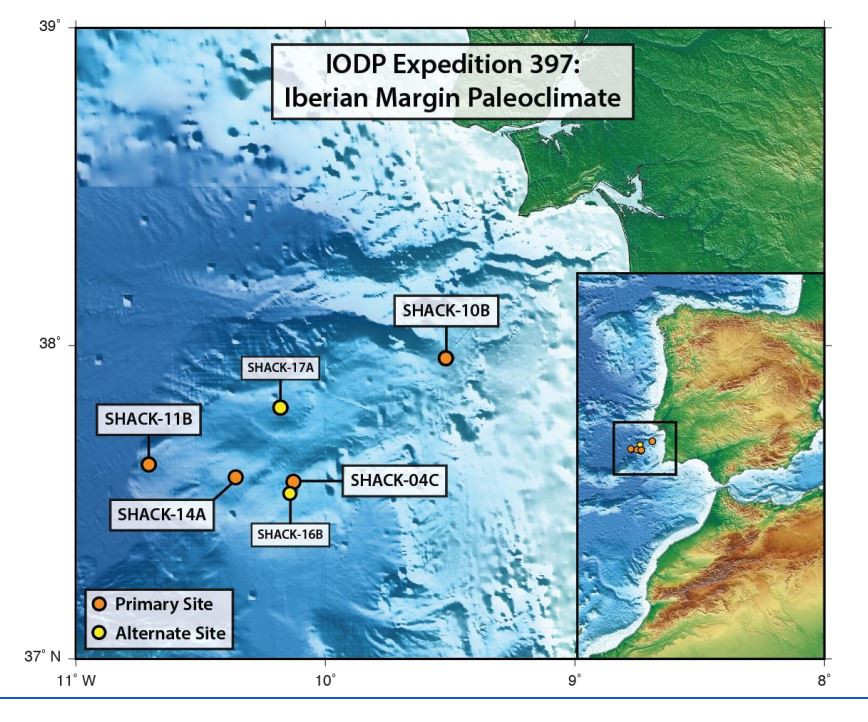

The narrow Portuguese continental shelf enables terrestrial material to reach the deep ocean quickly, making this one of the few places in the world where detailed connections can be established between marine, continental and ice records.
Until now, scientists knew that large ice sheets began expanding in the Northern Hemisphere around 2.7 million years ago, and that the climate underwent abrupt and rapid changes during the most recent glacial cycles. The key question was whether these oscillations were related to the growth of the ice sheets. This study shows that the first signs of millennial climate variability emerged at the start of this glaciation.
To identify signs of climate instability associated with debris carried by icebergs in the North Atlantic, the team conducted high-resolution geochemical analyses, including X-ray fluorescence (XRF), which was a key part of the study. This analysis revealed very subtle chemical variations in the sediments, enabling environmental changes that occurred millions of years ago to be reconstructed with great precision.
The results suggest that these rapid oscillations then began to recur systematically during glacial periods, becoming an intrinsic feature of the Quaternary climate. By releasing large volumes of ice and fresh water, these systems altered ocean circulation and heat transport, triggering rapid and abrupt climatic responses.
This research highlights the significance of the Iberian Margin (and the efforts of Portuguese institutions) as one of the few places in the world where detailed links can be established between marine, continental and polar ice records. This contributes significantly to our understanding of how the Earth's climate system works.
The analyses of Site 1586 were carried out at IPMA, specifically in the EMSO-GOLD laboratories of the Marine Geology Division, with the support of the Paleoceanography and Paleoclimate group, which is part of CCMAR's Oceans and Climate Change Group.
References: