Published on
CCMAR attended the third United Nations Ocean Conference (UNOC3), held in Nice, France, co-organised by France and Costa Rica, between 9 and 13 June 2025. The event brought together more than 2,000 scientists, senior government representatives (including 50 heads of state) and civil society organisations, with the aim of accelerating action for the conservation, governance and sustainability of the oceans.
UNOC3 aims to mobilise all actors - governments, the private sector, academia and civil society - to accelerate concrete actions under Sustainable Development Goal 14, which protects oceans, seas and marine resources. One of the central goals is to advance commitments such as the creation of new Marine Protected Areas (with a target of 30 × 30) and the ratification of the High Seas Treaty.
Main results with echoes at CCMAR:
- Ratification of the High Seas Treaty: at the end of the conference, 50 countries (including the EU) signed the treaty, approaching the minimum required for its entry into force by January 2026.
- Commitments for protected areas: the event saw announcements of new Marine Protected Areas, reinforcing the scope of the 30×30 initiative (protection of 30% of the oceans by 2030).
- Moratorium on deep-sea mining: 37 countries now support the precautionary approach, signalling strong attention to the issue.
CCMAR was represented at different moments during UNOC3:
Lilian Krug played a prominent role at various moments during the event. She co-organised the session ‘Sustained funding for long-term ocean observations in support of global policy frameworks’, which reinforced the urgency of continuous investment in ocean monitoring. Lilian presented the work of POGO (Partnership for Observation of the Global Ocean) through a poster on scientific training programmes and participated in the ‘Meet the Expert’ initiative, dedicated to dialogue between scientists and the public.
One of the highlights was her speech at the conference's closing plenary session, where, on behalf of POGO, she summarised the appeal “No Data, No Action" - an international declaration that has also been signed by CCMAR.
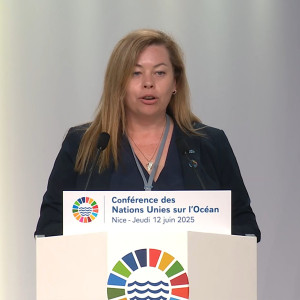
“Being present at UNOC3 was a strategic opportunity to reinforce the role of Portuguese science on the international stage, defend the importance of continuous ocean observation, and promote scientific training as a basis for climate action,” emphasises Lilian Krug.
During the conference weekend, CCMAR was also represented by researcher Jorge Gonçalves, at the First Meeting of POGO Directors, hosted at a parallel event to UNOC3.
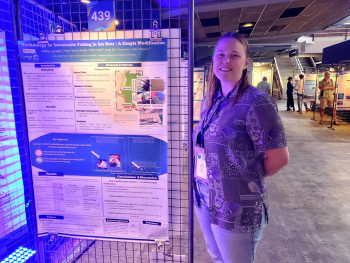
The conference also featured Monika Jadwiga Szynaka (OYSTER MEMBER), who presented a poster on the results of the first year of her Tramsel project, highlighting the successful adaptation of traditional fishing gear to reduce bycatch of habitat-forming species.
UNOC3 was a key moment for defining political and scientific commitments around the protection and sustainable use of the ocean. CCMAR's strong representation in these debates demonstrates the institution's commitment to producing knowledge that has a direct impact on public policy and the preservation of marine ecosystems.