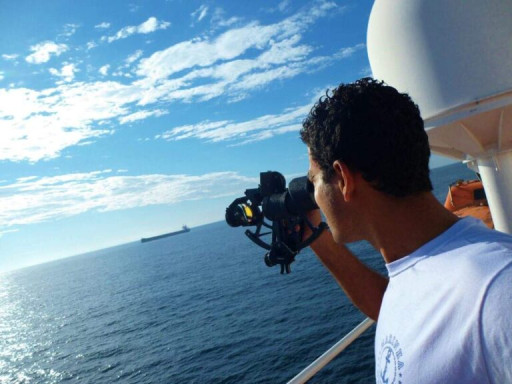
Caio Ribeiro, a researcher at the Algarve Marine Science Centre (CCMAR), has been honoured with the Atlantic Security Award. Presented by the Fundação Luso-Americana para o Desenvolvimento (FLAD), the Atlantic Centre and the National Defence Institute, the award recognises Ribeiro's project, which aims to identify areas of the Atlantic seabed with potential for mining that are sensitive to disturbance. The project aims to gather the knowledge necessary to inform policy decisions and protect vulnerable ecosystems, particularly at a time of growing demand for critical metals and increasing urgency to decarbonise the planet.
The energy transition requires scarce raw materials, such as rare earth metals, for the manufacture of batteries, solar panels, and digital infrastructure like electrical cables. The growing demand for these materials has led to increased interest in deposits located thousands of metres beneath the Earth's surface. However, the environmental risks of deep-sea mining are not well understood. In 2025, Portugal became the first country to ban mining in its territorial waters until 2050. More recently, at the United Nations Ocean Conference (UNOC 2025), world leaders renewed their call for a global moratorium on deep-sea mining. This preventive measure allows scientific knowledge to keep pace with the industrial push for deep-sea mining.
“This race for deep-sea resources is happening. But at the same time, there must be a race for science," explains Caio Ribeiro, alluding to the need to gain a better understanding of the areas to be explored in order to measure and predict their impact. ‘Only then will we understand what we have — and what we stand to lose. In this case, that would be biodiversity."
Entitled ‘Mapping and Monitoring Areas of Potential Deep-Sea Mining in the Atlantic’, the winning project of the Atlantic Security Award aims to compile and analyse all existing scientific literature on deep-sea ecosystems in the Atlantic. The project will then identify the potential impacts of deep-sea mining, such as sediment disturbance, the release of metals into the water column, constant noise from machinery and the introduction of light into permanently dark environments. The outcome will be a map showing areas of ecological knowledge and risk, assessing the sensitivity of these areas based on recorded biodiversity, level of study and ecological vulnerability. The researcher will present the project and receive the award on 30 October at 11:40 am at the Navy Museum in Lisbon.

"We will categorise areas according to their biodiversity, the extent of our scientific knowledge of them, and their ecological sensitivity. We will pay special attention to benthic organisms, as they are the most vulnerable to seabed disturbance."
The work will focus on sites that are considered to be the most likely to be mined, such as hydrothermal vents and polymetallic nodules. "Some of these areas are true oases of biodiversity. Hydrothermal vents, for instance, are home to unique species, many of which are still unknown and adapted to living without light, in symbiosis and under extreme pressures.”


The ambition is for this map to inform future decisions at national and international political levels during and after the Portuguese moratorium, as well as at the scientific level. This knowledge will be used as a starting point for new scientific expeditions and new monitoring and mitigation technologies. The map will also make a concrete contribution to the goals of the United Nations Decade of Ocean Science.
‘The moratorium until 2050 is a prudent decision, but it is preventative and temporary in nature. It is now up to us to establish a solid knowledge base to ensure that whatever path we take is grounded in science, not speculation,” Caio concludes.
Award presentation
Caio's presentation about the project: [3:39:39]