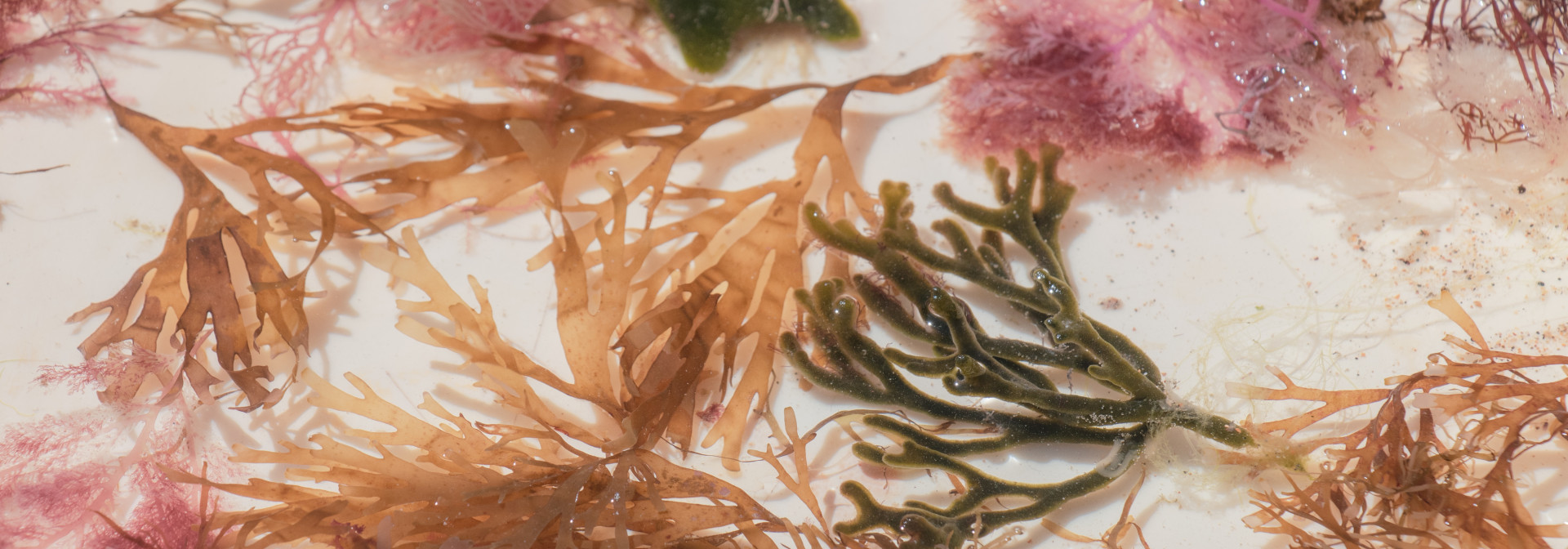
A new scientific paper led by Cícero Alves-Lima, a CCMAR researcher, presents a new methodology that could transform the way macroalgae are studied in laboratories.
Despite their ecological and economic importance, macroalgae are notoriously difficult to study in a laboratory setting. They exhibit a wide variety of forms and complex life cycles, and are prone to contamination by microorganisms. This makes the isolation of strains a slow, manual and poorly reproducible process. Consequently, many studies are based on small sample sizes and have statistical limitations.
However, the work carried out by a team, mainly from CCMAR, directly addresses this challenge. By standardising techniques such as the dilution and controlled fragmentation of algal biomass, combined with the application of chlorophyll fluorescence imaging, the team has developed a set of optimised protocols that enables them to quickly, accurately and cost-effectively isolate, analyse and characterise hundreds of macroalgal strains.
This new, quantitative, high-throughput approach is called SAMMBA (Seaweed Automatable Microplate Microscopy for Breeding Approaches). Using this method, at least 130 new strains can now be isolated across four experimental microplates, and growth rates can be quantified with high reproducibility in over 400 microcultures.
One of the key features of this method is its use of chlorophyll fluorescence to indicate growth and physiological performance. This signal is present in all algae and can be measured using conventional fluorescence microscopes, eliminating the need for dyes, genetic modifications or highly specialised equipment. This makes the protocol accurate and widely accessible to different laboratories.
According to Cícero Alves-Lima, this approach facilitates both fundamental biological research and practical applications. The researcher also highlights that the method is being adapted to select strains that are better suited to aquaculture and more tolerant of heatwaves in species that are highly relevant to Portugal, such as Laminaria and Ulva, in the context of ocean warming.
It is now possible to compare growth rates and physiological responses much more accurately and simultaneously across hundreds of strains.
Another cornerstone of the work is a commitment to open science. In line with the FAIR principles (findable, accessible, interoperable and reusable), all the raw data, analysis scripts and protocols associated with SAMMBA have been made available. This ensures that other researchers can reproduce, adapt and improve the method.
SAMMBA is more than just a new compilation of protocols; it represents a paradigm shift in experimental phycology. By transforming the isolation and phenotyping of macroalgae into a scalable, quantitative process, this method paves the way for more efficient biobanks, robust studies and innovative conservation strategies, leading to improvements in sustainable aquaculture.
The CCMAR Biobank, which is linked to the Portuguese Blue Biobank project and funded by the PRR, is already using SAMMBA to expand its collection and select more resilient strains in the face of anthropogenic climate change.