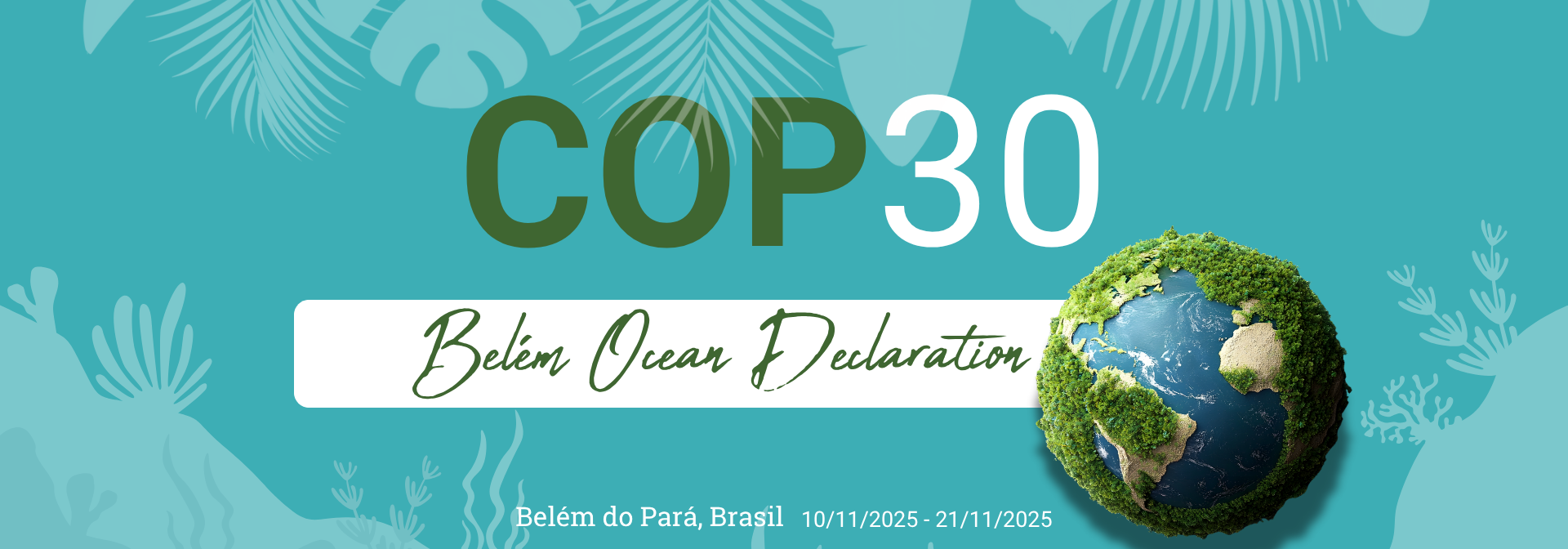
The Centre for Marine Sciences (CCMAR) is one of the signatories of theBelém Ocean Declaration, a manifesto that calls for the urgent integration of concrete measures to protect the ocean and forests into climate strategies and governance mechanisms.
Presented at COP30, in Belém do Pará, Brazil - a symbolic location where the Amazon meets the ocean – it highlights the deep connection between the two natural systems that regulate the planet's climate. The declaration has been signed by more than 60 international institutions, including the most prestigious marine science research centres, multilateral organisations, philanthropic foundations, universities, private entities and global scientific networks.
As an institute dedicated to the study of marine and coastal ecosystems, CCMAR joins this global coalition to advocate that the ocean must play a central role in climate action, reinforcing the need to integrate solutions for the oceans into national and international policies.
Ocean and forest: two inseparable pillars of climate stability
The Belém Ocean Declaration highlights that the ocean and forests are ‘twin pillars’ of climate stability. Both capture and store carbon, regulate global temperature, sustain essential biogeochemical cycles, and maintain the biodiversity on which societies around the world depend. The ocean, in particular:
- produces more than 50% of the planet's oxygen;
- absorbs about one-third of the CO₂ emitted by human activities;
- retains more than 90% of the additional heat generated by increased emissions;
- supports ecosystems and coastal regions that provide food, livelihoods and protection to billions of people.
However, these systems are under increasing pressure from climate change, ocean acidification, pollution, biodiversity loss and overexploitation. Even communities far from the coast are affected by ocean degradation, given its role in stabilising the climate and sustaining natural cycles.
Priority actions advocated by the Declaration
The Declaration calls for the deep integration of ocean protection and observation measures into climate and biodiversity strategies, proposing a set of priority actions, including:
- Recognising the ocean as a central regulator of climate, including it in national mitigation and adaptation strategies.
- Ensuring that ocean solutions are fair and accessible, with special attention to less developed countries, small island states and vulnerable coastal communities.
- Strengthening investment in ocean observation, mapping and monitoring, providing reliable data to guide policy and strengthen climate resilience.
- Accelerate nature-based solutions by restoring marine and coastal ecosystems essential to climate mitigation and adaptation.
- Create innovative and transparent financial mechanisms, involving the private sector and philanthropy to scale up marine conservation and sustainable blue economies.
These measures should be integrated into all climate action mechanisms — from nationally determined contributions (NDCs) to adaptation strategies, climate finance and global stocktake.
CCMAR's commitment
By signing the Belém Ocean Declaration, CCMAR reaffirms its commitment to producing sound scientific knowledge that supports effective public policies and sustainable solutions for the ocean. The work carried out in the Algarve - from the study of marine biodiversity to the monitoring of coastal ecosystems, including nature-based and science-based solutions for sustainable management - contributes to strengthening climate resilience at local, national and international levels.
COP30 represents a decisive moment to place the ocean at the centre of the global strategy to tackle climate change. CCMAR joins this international call for 2025 to be remembered as the year the world united land and sea to protect the planet and all forms of life that depend on it.
COP30 represents a decisive moment to place the ocean at the centre of the global strategy to tackle climate change. CCMAR joins this international call for 2025 to be remembered as the year the world united land and sea to protect the planet and all forms of life that depend on it.