The proposal has been put into practice in a practical guide developed as part of the DELASMOP project, a partnership between Centro de Ciências do Mar do Algarve (CCMAR) and the Interdisciplinary Centre for Marine and Environmental Research (CIIMAR) and proposes practical measures to reduce the by-catch of sharks and rays that are victims of trawling for crustaceans in the Algarve.
Crustacean trawling, although important for some coastal communities, has a considerable environmental impact and has discard rates of 70 per cent, affecting species of no commercial interest or under legal protection. These include rays and sharks, which are often caught as bycatch during this type of fishing. The data collected by the project's team of researchers reveals that 95 per cent of the rays and sharks caught as bycatch in trawls arrive on board dead or dying. To compound the problem, the pressure on coastal resources is pushing fleets into deeper waters where little-known species of great ecological importance live.
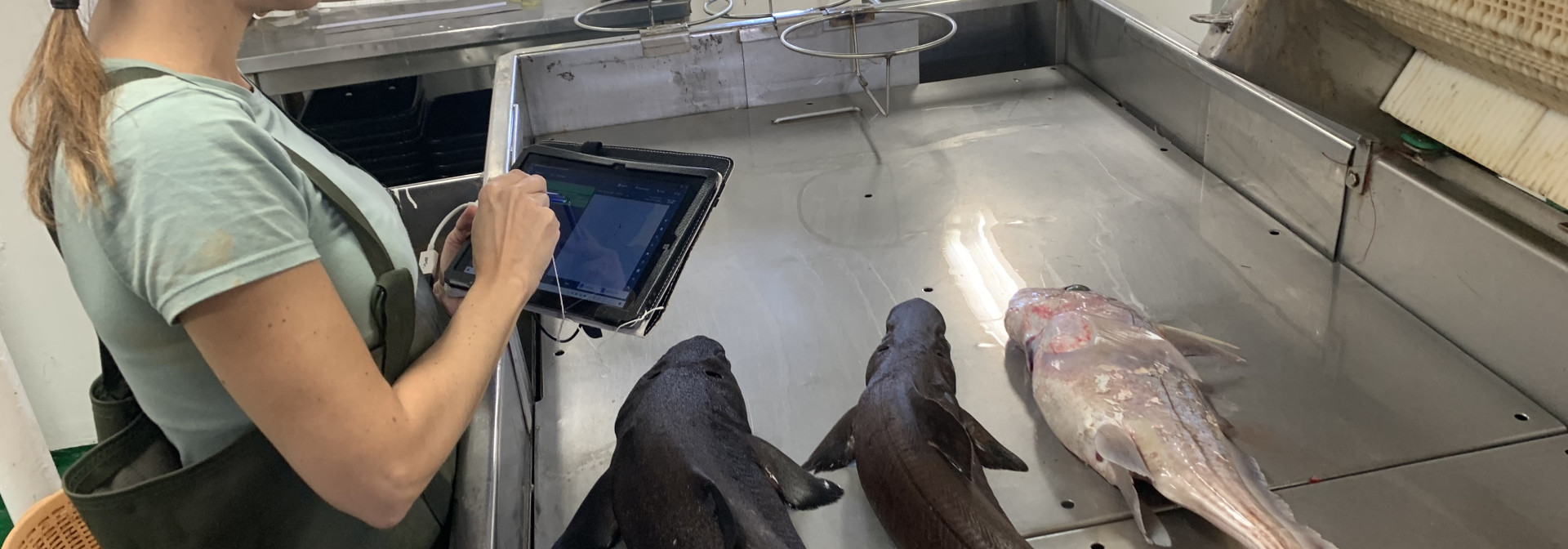
The ‘Guide to handling sharks and rays for trawlers’ was developed as part of the DELASMOP project, the result of Sofia Graça Aranha's doctoral thesis at CCMAR, whose research has centred on the study of deep-sea elasmobranchs: sharks and rays that inhabit the most unexplored marine ecosystems off the Algarve coast. Throughout her PhD, Sofia has dedicated herself to ‘better understanding these species, which are often invisible to the public eye but highly impacted by crustacean trawling,’ explains the CCMAR researcher. Her research focuses on non-lethal forms of assessment, using analyses such as stable isotopes and RNA/DNA ratios to determine the physiological state and survival rate of animals caught as bycatch.
Shark and ray species affected
In March 2021, during a field expedition as part of the DELASMOP project, 15 different species of deep-sea elasmobranchs were identified, including rarities such as the goblin shark (Mitsukurina owstoni), the enigmatic snake shark (Chlamydoselachus anguineus) and the peculiar sail hogfish (Oxynotus paradoxus). Bycatch has therefore become one of the main threats to the conservation of these animals. In this context, the practical guide now being developed is a response to current and emerging threats.
Alexandra Teodósio, Vice-rector at the University of Algarve (UAlg), CCMAR researcher and Sofia's co-supervisor, reinforces this idea: "The accidental capture of vulnerable species, such as deep-sea elasmobranchs, is a significant concern for marine conservation. This guide represents an important step towards promoting more sustainable fishing practices and protecting marine biodiversity and the vulnerable ecosystem of the deep ocean."
Recommendations for more sustainable fishing
Despite the European Union's ban on bottom trawling below 800 metres, the activity persisted during the years under study (2018-2022): ‘This guide was developed based on more than three years of direct observation on board vessels and offers solutions that fishermen can apply immediately to reduce impacts on fragile species,’ says Sofia Graça Aranha.
The ‘Shark and ray handling guide for trawlers’ is a valuable tool for supporting the fulfilment of Portugal's international commitments in terms of marine conservation, as well as contributing to the objectives of the European Green Deal and the EU Biodiversity Strategy for 2030. Among the measures proposed are strategies such as selecting fishing depths with a lower abundance of elasmobranchs, using meshes of different sizes and shapes, and reducing trawling time. It also recommends raising awareness and providing training amongst crews to enable the correct handling and identification of the species caught.
Collaboration and direct involvement of the community
The guide was developed with the involvement of fishermen through interviews and workshops. This participatory approach ensured that the recommendations were not only scientifically based but also adapted to the operational reality of the fleets.
Ester Dias, a researcher at CIIMAR and Sofia's co-supervisor, also explains the importance of institutional and fishing industry collaboration: "Collaboration between research institutions and the fishing industry is crucial to developing effective solutions. We hope that this guide will be adopted by trawler fishermen, contributing to the sustainability of fisheries and the conservation of deep-sea species." The ‘Shark and ray handling guide for trawlers’ is available at the CCMAR website and can be downloaded in this LINK.
About CIMAR-LA:
CIMAR-LA unites two centres of excellence in marine research in Portugal: CIIMAR and CCMAR. This associated laboratory is committed to developing ocean science with the aim of providing social benefits and boosting sustainable development.
CIMAR-LA's mission encompasses understanding, protecting and sustainably exploiting the full potential of marine and aquatic ecosystems through multidisciplinary research, innovation and advanced training. In addition, it promotes excellence in research areas relating to the marine environment, enabling a coordinated response that supports public policies at regional, national and international scales.
About DELASMOP:
The guide was developed as part of the DELASMOP project, which was the result of a partnership between the Centro de Ciências do Mar do Algarve (CCMAR) at the University of the Algarve, the Interdisciplinary Centre for Marine and Environmental Research (CIIMAR) at the University of Porto, and the Instituto Português do Mar e da Atmosfera (IPMA). It was funded by the Save Our Seas Foundation and the Fundação para a Ciência e Tecnologia (FCT) and also received technical support from the company OLSPS marine.