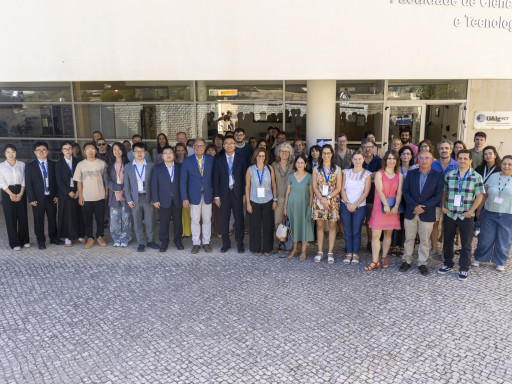
The XXI Congress of the Portuguese Society for Ethology (#SPEetol2025), supported by CCMAR, gathered close to 100 participants at the University of Algarve’s Penha Campus for two days of scientific exchange focused on animal behaviour in a changing world. Approximately 28 oral communications and 15 posters were presented, spanning freshwater, marine and terrestrial animals.
This year’s edition highlighted the breadth of ethology in Portugal and beyond, bringing together early-career scientists and senior researchers to discuss welfare, cognition, communication, climate impacts and social behaviour.
Pre-conference workshop
The meeting was preceded on 29 October by a hands-on workshop led by Ásgeir Bjarnason (Star-Oddi), who introduced participants to the use of advanced data loggers to monitor animal movements and physiology — a promising tool for ethological research.
Day 1 — Welfare & Acoustic Communication
The conference opened on 30 October with remarks from the Portuguese Ethological Society, followed by the first plenary talk from Melissa Bateson (Newcastle University, UK). Her talk demonstrated how behavioural principles can help explain variation in human and animal feeding behaviour and physiology, offering insights on why we behave and even look different under different perceptions of food abundance.
The opening session, Welfare, introduced key reflections on the importance of environmental enrichment and habituation in behavioural studies. Talks in this session explored how environmental enrichment and habituation shape behaviour and welfare across species, from gilthead seabream and seabass to nurse hounds. Presenters also showcased new tools such as deep-learning analysis for fish pose estimation, highlighting advances in behavioral monitoring.
The afternoon unfolded into the Acoustic Communication session, featuring sound-mediated behaviour, with research covering activities & acoustics of short-beaked common dolphins, variation in begging calls & offspring recognition, physiological stress & hearing loss in fish, behavioural responses to marine traffic noise, and collective anti-predator responses under noise exposure.
Together, these talks highlighted the widespread effects of anthropogenic noise pollution on communication and behaviour across taxa.
A poster session, followed by the SPE plenary meeting and a delicious social dinner, concluded the day.
Day 2 — Signals, Cognition, Climate & Sociality
The second day began with welcome remarks from Jorge Gonçalves (CCMAR), followed by a plenary talk by Sandra Trigo (CIBIO, Portugal) who presented new findings on how sex-differences in ornamentation are expressed and regulated in birds — offering a compelling view of the evolutionary mechanisms shaping signalling and reproductive strategies. Her talk offered an evolutionary perspective on how sexual traits develop, the physiological pathways that support them, and what they reveal about selection.
The first themed session, Evolution and Mechanisms of Signal Expression, focused on the development and function of signalling traits. Speakers discussed how communication systems evolve, how signals are produced and perceived, and what they reveal about fitness and species interactions. Talks explored how signals arise, vary, and influence species ecology.
Following the morning break, the focus turned to Cognition. This session showcased work on the evolution of cognition in fishes — highlighting variation across taxa and environments, and how cognitive traits influence survival and decision-making. The session highlighted the ecological relevance of mental perspective of animals and how environmental context shapes behavioural flexibility.
The final morning session, Behaviour in a Changing World, turned attention to global change, featuring studies on how extreme temperatures, heatwaves, and artificial light pollution influence behaviour. These talks underscored the vulnerability of behavioural processes to climate-driven pressures and urbanisation. Collectively, these studies emphasised how global change is reorganising behavioural processes, with consequences for survival and ecosystem functioning.
The last plenary, delivered by José Ricardo Paula (MARE / Universidade de Lisboa), explored complex behaviour through the lens of cleaning mutualisms — a field where behavioural dynamics unlock understanding of cognition, cooperation, and negotiation between cleaners and clients. This discussion sparked a lively and though-provoking discussion on the ability of fishes to be self-aware.
The congress concluded with the session Sociality and Behavioural Interactions, where researchers examined how social structure shapes behaviour over time and how individuals interact within dynamic group settings.
The final conference talk was delivered by Peter McGregor (ISPA) with an update on Acta Ethologica, reviewing the journal’s developments over the past year.

Sessão plenária de Melissa Bateson (Newcastle University, UK)

Sessão Plenária de Sandra Trigo (CIBIO, Portugal)

Sessão Plenária de Ricardo Paula (MARE / Universidade de Lisboa)

João Grave - Melhor Poster - Indirect effects of cleaner gobies on fish grazing and benthic community structure

Pedro Santos - Vencedor Prémio Vítor Almada (12ª edição) - Noise shapes collective anti-predator response

Antony Pieters Menção Honrosa - Melhor Oral - The influence of calf-initiated behaviors on common dolphin (Delphinus delphis) group

Peter McGregor (ISPA) sessão de encerramento
Recognising Excellence
This year’s congress also celebrated outstanding student contributions.
🥇 Vítor Almada Award — Best Student Talk
Pedro Santos, “Noise shapes collective anti-predator response”
🥈 Honourable Mention — Student Oral Presentation
Antony Pieters, “The influence of calf-initiated behaviors on common dolphin (Delphinus delphis) group dynamics along the South coast of Portugal”
🏆 Best Poster Presentation
João Grave, “Indirect effects of cleaner gobies on fish grazing and benthic community structure”
Collective Effort
The success of #SPEetol2025 was made possible through the commitment of its organising committee, Fish Ethology and Welfare, and all the presenters, exhibitors and participants who contributed to two days of lively scientific exchange.
The Congress showcased the diversity and quality of behavioural research taking place in Portugal and highlighted how modern ethology bridges laboratory and field approaches, spanning welfare, communication, cognition and environmental change.
CCMAR is pleased to have supported this edition of the conference and looks forward to future opportunities to strengthen dialogue, collaboration and innovation in the study of animal behaviour.