Cold-water corals play a vital role in shaping marine ecosystems, providing shelter and food for countless species that inhabit areas from the continental shelf to the ocean’s abyssal depths. However, their sedentary nature and slow growth rates make these corals highly vulnerable.
It was precisely this combination of importance and fragility that prompted a team of researchers from CCMAR to seek answers to two key questions: where exactly are the world’s cold-water corals located, and how might climate change alter their distribution?
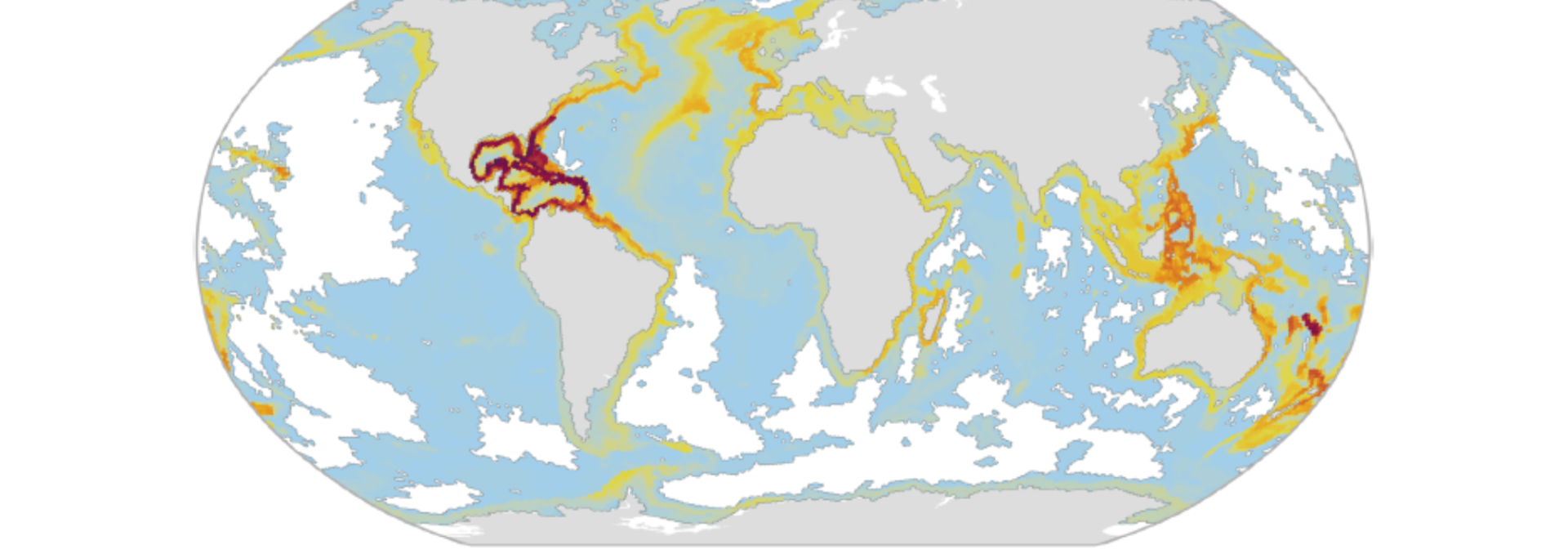
To tackle these issues, the researchers turned to machine learning tools to analyse 741 coral species and create the first-ever global map of their biodiversity. Published in Global Change Biology, the study not only charts the current distribution of these species but also projects their potential future under different greenhouse gas emission scenarios.
“Our models took into account the complex parameters that define coral habitats, such as physical conditions (for example, temperature), habitat complexity (like seabed roughness), and hydrodynamic factors (such as currents that influence the feeding of filter-feeding animals like corals),” explains Eliza Fragkopoulou, the study’s lead author.

“This allowed us to observe that various coral types respond similarly to the environmental conditions they inhabit. We were therefore able to group them into ten distinct clusters and identify the regions of the world with the greatest diversity of cold-water corals.”
But the goal was not merely to map the present — it was to anticipate the future. The researchers found that the scale of the impending changes is directly proportional to the level of greenhouse gas emissions.
Under a high-emissions scenario, widespread losses and major restructuring of deep-sea communities are anticipated. Coral populations are expected to migrate towards cooler latitudes and deeper waters. Conversely, coastal zones and biodiversity hotspots such as the Gulf of Mexico could lose a significant proportion of their endemic species.
“These changes will affect not only the corals themselves but also the entire ecosystem that depends on them,” stresses Jorge Assis, who led the research team. “The message is clear: we must meet the targets of the Paris Agreement and strengthen networks of Marine Protected Areas to help mitigate the cumulative effects and build long-term resilience for these deep-sea ecosystems”
The newly created map provides a crucial foundation for global conservation efforts, highlighting regions most in need of protection and those that may serve as future climate refuges. It also serves as a reminder that, even in the unseen depths, ocean life remains intimately connected to the choices we make at the surface.


Reference:
- Article published in Wiley's Global Change Biology journal: Global Cold-Water Coral Biodiversity Redistribution Under Projected Climate Change